
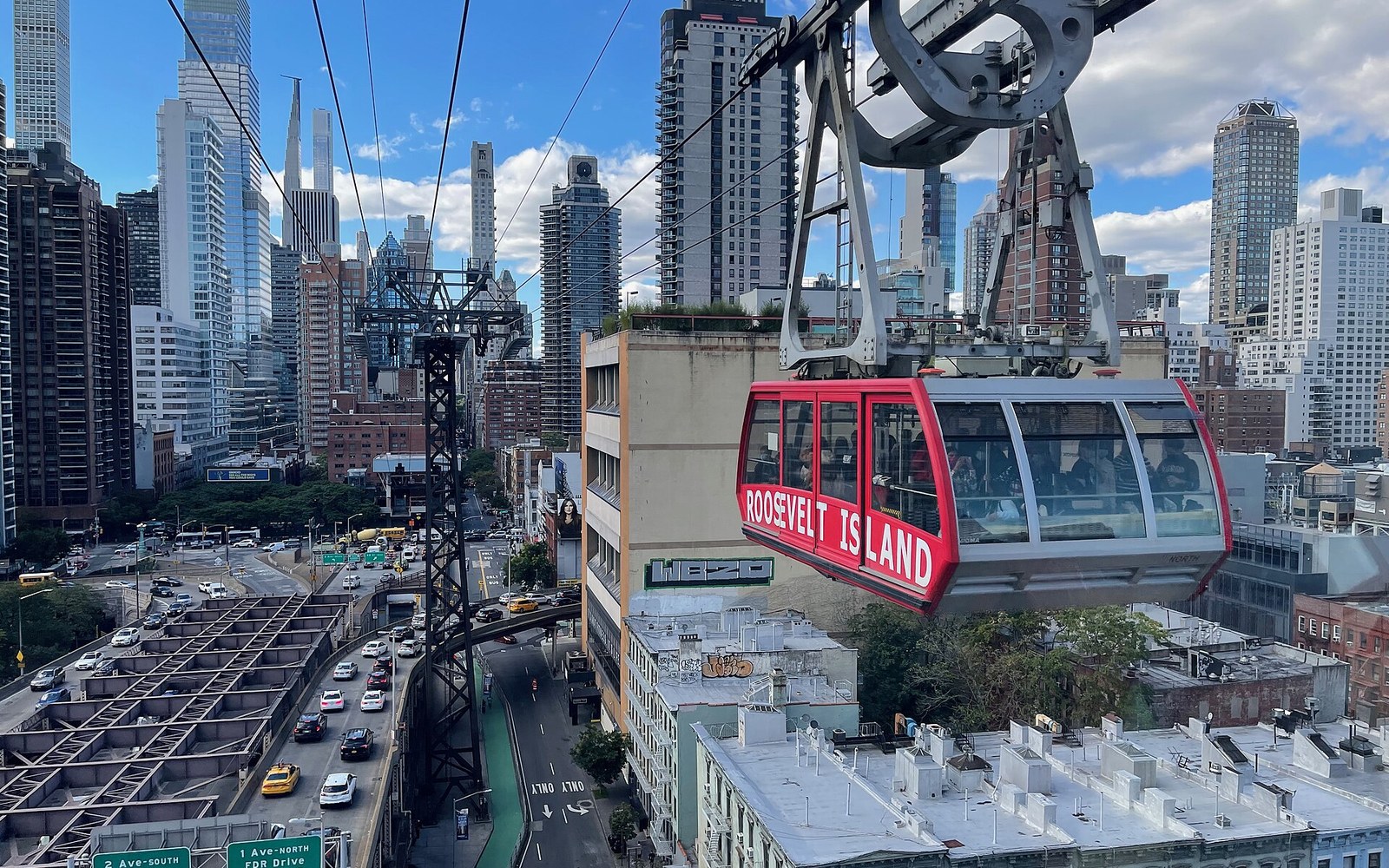
The Roosevelt Island Tram is the most underrated ride in New York. It costs a single subway fare, it climbs 250 feet over the East River, and it drops you on a two-mile island whose entire western shore faces the Manhattan skyline. Almost nobody plans a day around it. They should.
Allow three to four hours from Midtown and back. Nearly all of it is free.
The route at a glance
| Time | Stop | Roughly |
|---|---|---|
| 14:00 | Tram station, 59th St & Second Ave | 15 min |
| 14:15 | Tram crossing to Roosevelt Island | 5 min |
| 14:20 | Walk south along the west promenade | 40 min |
| 15:00 | Four Freedoms Park and the island's southern tip | 45 min |
| 15:45 | Walk north, Blackwell House and the lighthouse end | 45 min |
| 16:30 | Tram back at golden hour | 20 min |
Getting on the tram
The Manhattan station is at East 59th Street and Second Avenue, a short walk from the Lexington Avenue subway lines and the 63rd Street F platform. The tram is run as part of the city's transit system, which is the key thing to know: you tap OMNY or swipe a MetroCard exactly as you would on a bus or subway, at the same fare. A tap gives you the standard free transfer window, so a subway ride out and the tram itself can be one fare. Unlimited MetroCards are accepted. Cabins leave every seven to fifteen minutes depending on the hour and run late into the night.
Stand at the front of the cabin on the right-hand side going over. That is the side that looks down the river towards the Queensboro Bridge and Midtown.
14:20 — The west promenade
Come out of the island station and go west to the shoreline, then turn south. The promenade here is a continuous paved path with a low rail and, across maybe 300 metres of water, the entire east face of Manhattan: the UN Secretariat, the Chrysler Building's crown, Sutton Place, the Queensboro Bridge behind you. There are benches the whole way and it is usually near-empty on a weekday.
Photo stop: anywhere along the promenade between the tram and the ruins of the old Smallpox Hospital, where the skyline sits square in frame with no foreground clutter.
15:00 — Four Freedoms Park
The island narrows to a point at its southern end, and the last stretch is Franklin D. Roosevelt Four Freedoms Park — a memorial by architect Louis Kahn, finished decades after his death. It is austere on purpose: a triangle of lawn between two rows of trees, narrowing to a granite room open to the sky and the harbour. Admission is free. Check the park's hours before you go, as it closes earlier than the rest of the island and is shut one day a week.
Just before it you pass the stabilised ruin of the Renwick Smallpox Hospital, the island's Gothic reminder that this was once where the city sent people it wanted out of sight.
15:45 — Walk north
Head back up, this time on the eastern side if you want the Queens waterfront and quieter residential blocks, or straight up Main Street to see how the island actually lives — a planned community of apartment buildings, a school, a library and a farmers market on Saturdays. Blackwell House, one of the oldest farmhouses left in New York City, sits mid-island and is free to visit.
If you have the legs, keep going to the northern tip and Lighthouse Park, where an 1872 stone lighthouse marks the point where the river splits. It adds a mile each way — a full afternoon rather than a half day.
16:30 — The ride back
Time your return for the hour before sunset. Going west, the tram climbs directly towards the Midtown skyline with the light behind it, and it is the single best skyline photograph in New York that does not cost a cent beyond a subway fare. On a clear evening, wait for the next cabin rather than squeeze into a full one — you want space at the window.
Practical tips
- Cost: one transit fare each way. Four Freedoms Park, the promenade and Blackwell House are free.
- Best time: late afternoon into sunset, any season. Clear, cold winter days give the sharpest views.
- Weather: the promenade is fully exposed. In wind off the river it feels ten degrees colder than Midtown.
- Food: options on the island are limited and mostly along Main Street. Eat before you go, or plan dinner back in Manhattan.
- Backup: if the tram is closed for maintenance, the F train stops at Roosevelt Island and the NYC Ferry Astoria route serves the island too.
- Accessibility: the tram cabins and both stations are step-free, and the promenade is flat and paved the whole way.
Where to go next
This pairs naturally with other no-cost days out — see our guide to free things to do in NYC year-round. If you want the paid, high-altitude version of the same skyline, SUMMIT One Vanderbilt is fifteen minutes away by subway from the Manhattan tram station.